This webpage last updated on 2026-06-20
Last updated: 2026-06-20
Vintage Valentine's Day Postcards | History, Romance & Collecting
Affiliate Disclosure:
This website includes affiliate links from Amazon, Google, and Awin (Share-a-Sale). Purchases made through these links may generate small commissions, at no extra cost to you, for qualifying clicks or purchases.
Valentine's Day postcards offer a charming glimpse into how people shared affection before modern digital communication. By the late nineteenth century, Valentine greetings were already a major commercial tradition in the United States, and when the Library of Congress notes the importance of Valentine greetings in the 1880s and the Smithsonian Institution Archives explains the 1907 divided-back postcard change, the result helps show why postcards became such an appealing format during the period now remembered as the Golden Age of Postcards.
During that era, Valentine's postcards often featured cupids, hearts, flowers, and romantic imagery, combining sentiment with the colorful printing styles of the early twentieth century. As explained in Hallmark's history of Valentine's Day, these symbols became closely associated with the holiday, while postcard popularity eventually gave way to folded greeting cards. Hallmark itself began selling Valentine postcards in 1910 and introduced its first Valentine greeting cards in 1916, marking a shift in how people exchanged seasonal messages.
Today, antique Valentine's postcards remain appealing because they preserve both the artistry and the everyday social customs of their time. The National Endowment for the Humanities describes how postcards supplanted many earlier lace-style valentines, while examples preserved by the Library of Congress postcard collections show the playful, romantic, and decorative character that still makes vintage Valentine postcards so memorable today.
To My Valentine ...
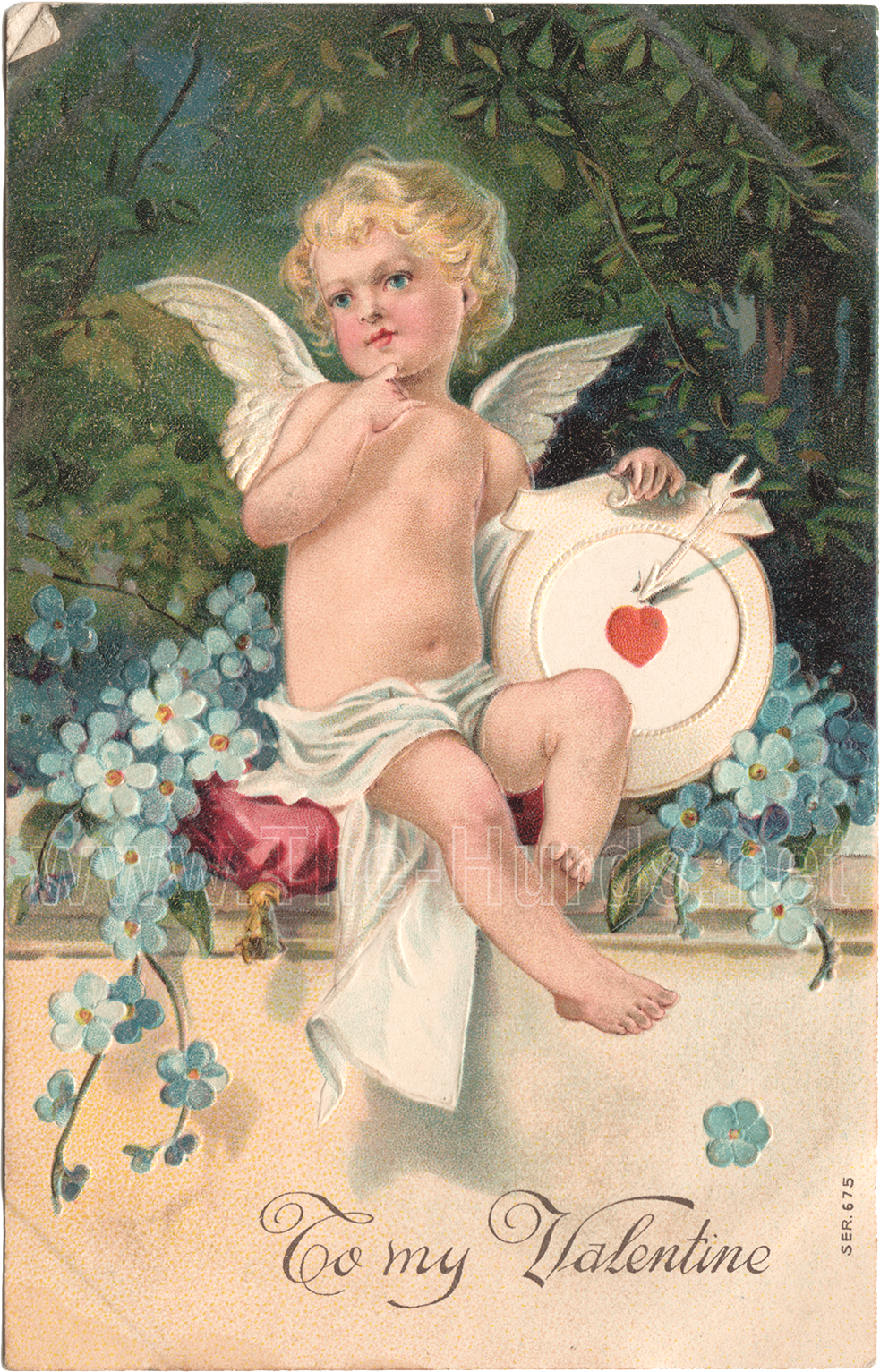
This postcard is an embossed, German-printed Valentine postcard made for the U.S. market, part of Series 675, and used in or about February 1914. The exact full publisher name is not printed on the reverse. The artist also remains unknown, since no readable signature or artist credit is visible on the postcard. Even so, the card stands as a very strong and attractive example of an early twentieth-century Valentine postcard, combining Cupid imagery, floral ornament, embossing, and elegant sentiment in the style that made these cards so memorable.
The reverse provides an important manufacturing clue, plainly marked “PRINTED IN GERMANY.” That detail strongly supports the postcard’s place within the great wave of German-made holiday and novelty postcards that were produced for the American market during the golden age of postcard collecting. The multilingual heading across the top and the divided-back format are both typical of internationally distributed postcards from the years after 1907, while the raised embossing visible through the reverse confirms that this was designed as a tactile, decorative Valentine card rather than a simple flat-printed souvenir.