This webpage last updated on 2026-06-23
Last updated: 2026-06-23
Vintage State of Ohio Postcards
Affiliate Disclosure:
This website includes affiliate links from Amazon, Google, and Awin (Share-a-Sale). Purchases made through these links may generate small commissions, at no extra cost to you, for qualifying clicks or purchases.
Ohio vintage postcards offer a visual path through one of the most historically important states in the old Northwest Territory. Long before these postcard views were printed, the region known as the Ohio Country was shaped by Indigenous communities, frontier settlement, river travel, and the westward growth of the early United States. The National Archives explains that Ohio legally became the seventeenth state through the February 19, 1803 act of Congress, while March 1, 1803 is celebrated as Ohio's statehood date because that is when the first state legislature met.
Many Ohio postcard subjects reflect the state's role as a crossroads of transportation, commerce, agriculture, and industry. Lake Erie ports, Ohio River towns, canal routes, railroad centers, courthouse squares, factories, bridges, and main streets all became natural postcard subjects because they represented the places where people worked, traveled, and gathered. The National Park Service describes how the Ohio & Erie Canal connected Lake Erie with the Ohio River, helping tie Ohio into a broader national market and transforming communities along its route.
As collectible ephemera, Ohio postcards preserve both large landmarks and ordinary scenes that might otherwise be forgotten: depots, schools, churches, lakefront resorts, hotels, mills, street scenes, public buildings, scenic overlooks, and small-town business districts. The Smithsonian Institution Archives explains that the 1907 divided-back postcard change helped usher in the period often called the Golden Age of Postcards, making early twentieth-century Ohio postcards especially useful for studying how communities presented themselves to travelers, residents, and distant correspondents.
F.G. Meyer, Jeweler, Dayton, Ohio
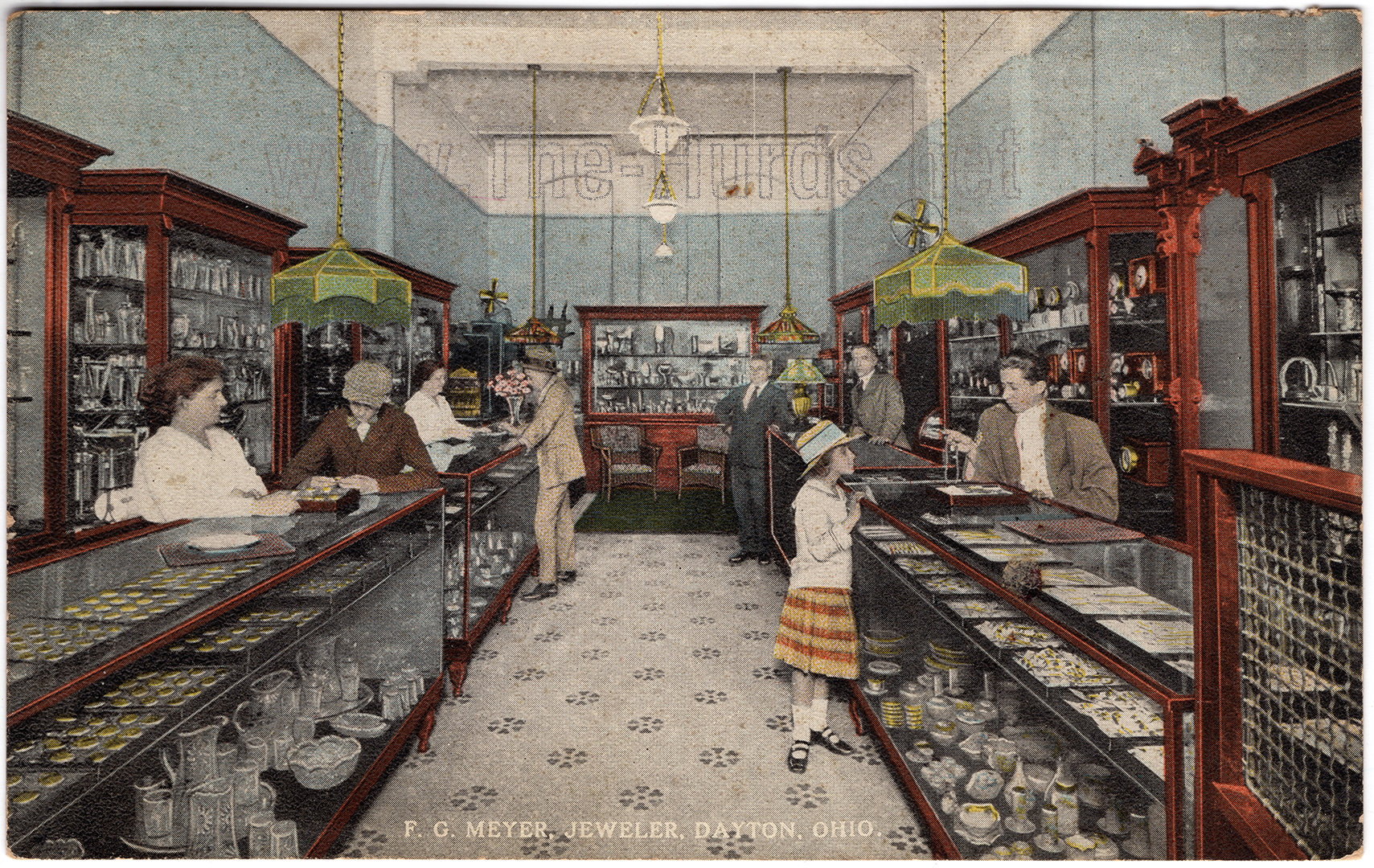
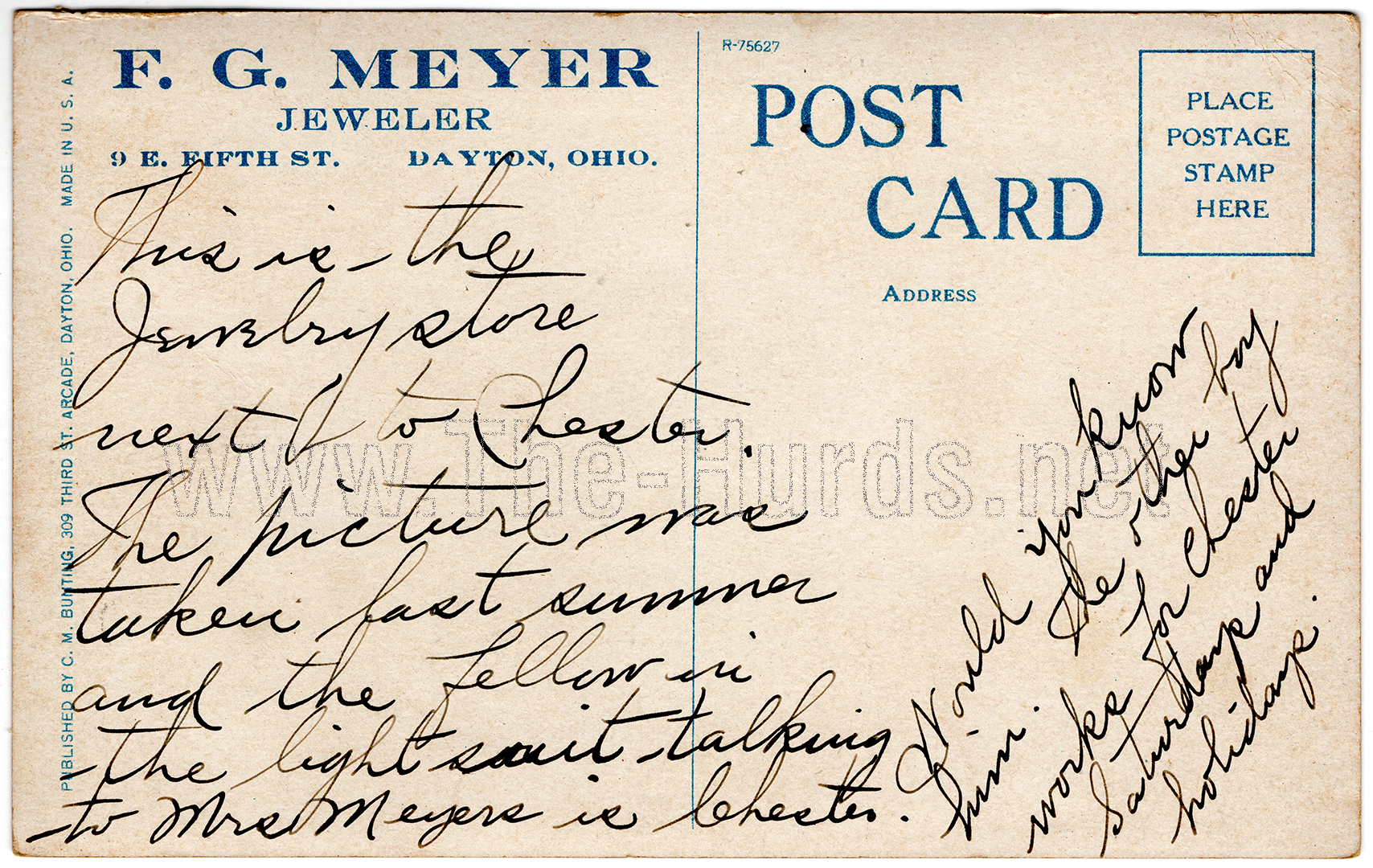
This postcard is especially interesting because its reverse side does not simply carry a casual message; it helps identify people shown in the photographic scene. Although there is no stamp or postmark to provide a mailing date, the writer notes that the picture was taken “last summer” and describes the location as the jewelry store next to Chester. The business shown is F. G. Meyer Jeweler, formerly located at 9 E. Fifth Street in Dayton, Ohio, and the card was published locally by C. M. Bunting, 339 Third Street, Arcade, Dayton, Ohio. The reverse also carries the identification number R-75627.
The handwritten message reads, "This is the jewelry store next to Chester. The picture was taken last summer and the fellow in the light suit, talking to Mrs Meyers is Chester. would you know him. The other boy works for Chester Saturdays and holidays."
The handwritten message gives the postcard a level of personal and local-history significance that many street-view postcards do not have. The writer identifies “the fellow in the light suit” as Chester and states that he is talking to Mrs. Meyers (sic), while also noting that another boy in the image worked for Chester on Saturdays and holidays. These details suggest that the people in the photograph were familiar to the sender, and perhaps to the recipient as well. Rather than being only a view of a Dayton storefront, the card becomes a small documented moment in the everyday life of a neighborhood business district.
If you recognize the storefront, the F. G. Meyer Jeweler name, the C. M. Bunting postcard publisher, the East Fifth Street location, Chester, Mrs. Meyers, or any family connection to the people shown on the front of this postcard, your insight could add important context to this piece of Dayton history. Personal identifications like the one written on this card can help connect a surviving postcard image with real people, occupations, family stories, and local businesses. Even a small association, such as a remembered surname, a business directory listing, a family photograph, or a story passed down through a Dayton family, may help preserve the meaning of this image more fully.
The F. G. Meyer Jeweler shown on this postcard should not be confused with the later Fred Meyer Jewelers chain. Although the names are similar, the Dayton postcard business is documented as a local Ohio jeweler, while the modern Fred Meyer Jewelers chain traces its history to a 1973 catalog-showroom jewelry operation in Albany, Oregon. Current Fred Meyer Jewelers locations are associated with the Kroger family of stores and are found in states such as Oregon, Washington, Idaho, Utah, and Alaska, rather than being a known continuation of the F. G. Meyer Jeweler business shown here.
Administration Building, Municipal Airport, Cleveland, Ohio
Caption on reverse reads:
The Administration Building houses the executive and general offices from which the successful operation of Cleveland's Municipal Airport is conducted. The observation tower on the building controls the taking-off and landing of all planes using the Airport. From this building is also broadcast to pilots such necessary information as weather reports and directional signals.